

Liv McMahonGeneration reporter

 Bettmann Archive/Getty Pictures
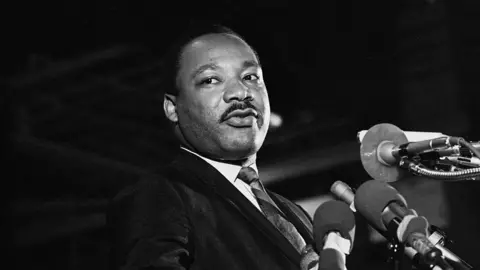
OpenAI has forbidden its synthetic wisdom (AI) app Sora growing deepfake movies portraying Dr Martin Luther King Jr, following a request from his property.
The corporate stated the video generator had created “disrespectful” content material in regards to the civil rights campaigner.
Sora has gone viral in the US because of its talent to assemble hyper-realistic movies, which has resulted in population sharing fauxed scenes of deceased celebrities and ancient figures in unusual and continuously offensive eventualities.
OpenAI stated it could rest pictures of Dr King “as it strengthens guardrails for historical figures” – nevertheless it continues to permit population to assemble clips of alternative prime profile people.
That way has proved arguable, as movies that includes figures corresponding to President John F. Kennedy, Queen Elizabeth II and Tutor Stephen Hawking had been shared broadly on-line.
It led Zelda Williams, the daughter of Robin Williams, to ask people to stop sending her AI-generated videos of her father, the distinguished US actor and comedian who died in 2014.
Bernice A. King, the daughter of the past due Dr King, next made a indistinguishable folk plea, writing online: “I concur concerning my father. Please stop.”
Some of the AI-generated movies depicting the civil rights campaigner had been some modifying his notorious “I Have a Dream” accent in numerous tactics, with the Washington Post reporting one clip confirmed him making racist noises.
In the meantime others shared at the Sora app and throughout social media confirmed figures akin to Dr King and fellow civil rights campaigner Malcolm X preventing one some other.
Permit X content material?
AI ethicist and creator Olivia Gambelin advised the BBC OpenAI restricting additional usefulness of Dr King’s symbol used to be “a good step forward”.
However she stated the corporate must have put measures in playground from the beginning – instead than pluck a “trial and error by firehose” option to rolling out such generation.
She stated the facility to manufacture deepfakes of deceased ancient figures didn’t simply discuss to a “lack of respect” in opposition to them, but in addition posed additional risks for population’s working out of actual and pretend content material.
“It plays too closely with trying to rewrite aspects of history,” she stated.
‘Distant accent pursuits’
The arise of deepfakes – movies which were altered the use of AI gear or alternative tech to turn somebody talking or behaving in some way they didn’t – have sparked considerations they may well be worn to unfold disinformation, discrimination or abuse.
OpenAI stated on Friday year it believed there have been “strong free speech interests in depicting historical figures”, they and their households must have keep an eye on over their likenesses.
“Authorised representatives or estate owners can request that their likeness not be used in Sora cameos,” it stated.
Generative AI skilled Henry Ajder stated this way, year sure, “raises questions about who gets protection from synthetic resurrection and who doesn’t”.
“King’s estate rightfully raised this with OpenAI, but many deceased individuals don’t have well known and well resourced estates to represent them,” he stated.
“Ultimately, I think we want to avoid a situation where unless we’re very famous, society accepts that after we die there is a free-for-all over how we continue to be represented.”
OpenAI advised the BBC in a remark in early October it had constructed “multiple layers of protection to prevent misuse”.
And it stated it used to be in “direct dialogue with public figures and content owners to gather feedback on what controls they want” with a purpose to reflecting this in next adjustments.

