



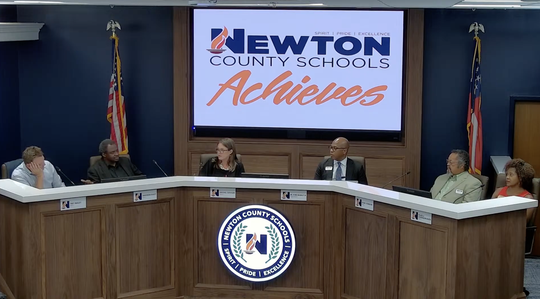

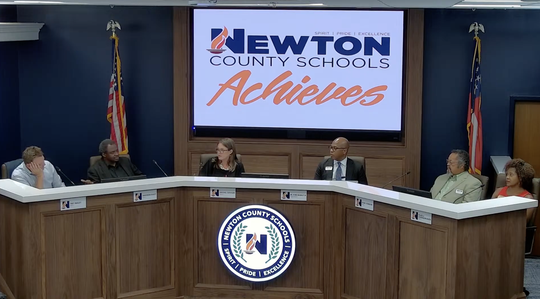
NEWTON COUNTY — Upcoming a flurry of failed motions, the Newton County Board of Training narrowly handed a millage charge of 15.5 generators at Tuesday evening’s paintings consultation. It is a 0.25-mill shorten from final occasion’s charge of 15.75.
Following plenty of unsuccessful motions for decrease charges — together with 15.7 generators, 14.84 generators, 15.65 generators and 15.447 generators — District 4 Consultant Anderson Bailey made a movement to cross a millage charge of 15.5 generators. This movement used to be seconded through District 3 Consultant Shakila Henderson-Baker.
Despite the fact that it handed, the vote used to be crack. Regardless of seconding the movement to cross 15.5 generators, Henderson-Baker voted in opposition. With District 2 Consultant Eddie Johnson opting to abstain, the vote handed 3-1 because of a last-minute ‘aye’ from District 1 Consultant Trey Bailey.
Even with the lowered millage charge, house owners can nonetheless be expecting their detail taxes to extend in comparison to final occasion. With house values converting every occasion, a board should undertake the whole rollback charge to deliver to reserve home-owner bills from expanding.
In line with the presentation, on a mean house this is valued at $325,000, underneath the 15.5 millage charge, taxes will likely be at $1,953.
Trey Bailey, Shakila Henderson-Baker push for rollback charge
Superintendent Dr. Duke Bradley III beneficial a somewhat lowered millage charge of 15.7 initially of the paintings consultation. Alternatively, the board individuals had other plans.
Trey Bailey have been an recommend for taking the whole rollback charge of 14.84 generators, many times mentioning that the board will have to no longer exceed 15.447 generators.
All the way through the 3rd and ultimate millage charge nation listening to, which took playground handiest hours prior to the board voted in its paintings consultation, Trey Bailey mentioned that his push for an important shorten used to be a philosophical determination, mentioning the board’s FY26 finances.
“In May, when we passed that budget, the millage rate that we would need to get the amount to $241 million in revenue would be 15.447 [mills],” Trey Bailey mentioned. “The 15.447 [mills], to me, is the highest millage rate we should even consider, because we passed a budget in May that said that’s all we need.”
Trey Bailey additionally addressed Space Invoice 581 (HB581), which the board of training voted to decide out of. HB581, if voted into impact, would have enacted a floating domicile exemption and saved detail values from expanding.
However Trey Bailey believes that enacting the domicile exemption would have pressured the board to boost the millage charge to build up that source of revenue. He pointed to the governing our bodies of Newton County and town of Covington, either one of which opted in to HB581 previous this occasion and feature since larger their millage charges.
With the board legally restrained from elevating the millage charge past 20 generators, Trey Bailey mentioned that the varsity district would temporarily max out the velocity and lose its method of producing backup source of revenue.
“We have the opportunity to roll this rate back, to show the community that when we opted out of House Bill 581, it’s because we knew we needed to control the millage rate,” Trey Bailey mentioned.
Trey Bailey driven for the board to show to its retain investment to build up any backup source of revenue, pronouncing that this used to be the plan when the finances used to be handed and that the board will have to no longer waver as a result of there’s a pristine alternative to fill that hole with taxes.
“This board passed a budget in May, $265 million, in which we knew that the estimated revenue was going to be $241 million,” Trey Bailey mentioned. “So we knew we would have to dip into the reserves for $24 million. And that would still leave us an ending fund balance of well over $32 million, so 12 percent plus in that ending fund balance.”
Trey Bailey’s push for the rollback charge used to be joined through Henderson-Baker, who additionally spoke at dimension concerning the matter throughout the paintings consultation. Alternatively, when he made a movement to cross the velocity at 14.84, it failed, with handiest Henderson-Baker balloting along him. A couple of mins then, some other movement for 15.447 failed with the similar aid.
Additional board dialogue
Despite the fact that outnumbered, Johnson remained firmly all set on retaining the millage charge at or above 15.75.
Federal and circumstance resources of investment and backup have reportedly been insecure because the Section of Training faces backup hurdles. Johnson pointed to this as a necessity for the board to keep away from depending on its reserves to investmrent customary operations.
“What would you do if the state told us that you’ve got to pay for all employees’ insurance? They’ve done it once, in part. What if that happens? What could you do?” Johnson requested. “…We’ve got to manage accordingly to some of the expectations. And the expectations are out there that yes, we’ve got to fund more of what we used to get from the state and the federal.”
Like Johnson, District 5 Consultant and Board Chair Abigail Coggin pointed to adjustments which have been coming i’m sick the pipeline, forcing the district to distinguishable its pockets in tactics it has no longer been known as to prior to now.
“Since we passed our budget, even in June, we’ve had changes from the federal government as well,” Coggin mentioned. “And we just don’t know. And that’s another reason why I don’t want to let our reserves go too low.”
Coggin’s worry over depleting retain budget used to be an issue she spoke on greater than as soon as. She voiced her fear that this investmrent had to stay intact for the district to dip into as unpredictable bills be on one?s feet. Alternatively, her reservations weren’t as intense as Johnson’s, as she remained in partial of a millage charge aid.
“I am all for reducing the millage rate, do not get me wrong,” Coggin mentioned. “I do not want to increase it, I don’t want to keep it the same and I do want to reduce it lower than what Dr. Bradley has recommended. My fear is the reserves, because we have to use that until we get the money in the bank.”
Motions for a fifteen.7 and 15.65 millage charge did not garner a majority vote.
In the end, next 4 failed motions, Anderson Bailey proposed a millage charge of 15.5. This handed with a 3-1 vote, with Trey Bailey siding with Anderson Bailey and Coggin on the final 2d.
Citizen issues, senior taxes
Despite the fact that disagree electorate opted to talk throughout the primary and 2d nation hearings, 4 public did remark on the ultimate listening to. An backup 3 public spoke throughout an allocated occasion for common nation participation initially of the paintings consultation.
The overpowering angle of those that got here to talk used to be that the tax burden on electorate has grow to be a ways too big, in particular for seniors. Many senior electorate are on a set source of revenue and don’t consider they will have to pay as a lot at school taxes when their kids are not within the college device.
“Other districts, other counties, do not have their seniors paying taxes from the board of education,” mentioned Edna McKenzie. “And I’m here to complain and ask why does Newton County continue to charge seniors for taxes when they do not have children in the system anymore?”
“At the age of…it’s well past 65, we want to know, when will you consider us?” mentioned Louise Cabo. “We cannot afford for our property taxes to go up any higher…Being a teacher for 31 years, I know what it’s like in the schools. I know what y’all need. I know it’s not easy. But, when you’re living on a pension, it’s not easy either.”
All the way through the 3rd nation listening to, the board individuals said that seniors have confronted a big tax burden. One of the vital conversations wondered the most productive mode for relieving this load.
Moment Trey Bailey mentioned that passing a decrease millage charge used to be pleasant a contract of then ease that used to be given when the board opted out of Space Invoice 581, Coggin pointed to the millage charge as having a moderately low have an effect on on one’s taxes in comparison to alternative modes.
In line with the presentation from Erica Robinson, important monetary officer, on a house assessed at $325,000 in worth, a millage charge of 15.75 would lead to $1,985 at school tax. Accepting the whole rollback of 14.84 would decrease this quantity to $1,870 — a $115 extra.
“I agree wholeheartedly with you [Trey Bailey] philosophically about the HB581, and we want to do something significant,” Coggin mentioned. “The fact is, this millage rate is not that significant. It’s $100 basically. However, if we did a [local] homestead exemption, increased it for seniors, that’s where you’re going to make more of a chunk, so to speak, and more of a difference.”
Bradley shared a alike sentiment to Coggin in that he felt that providing the folk a tax split could be higher achieved via some other mode.
“This is an estimate; I think the range of savings from holding the millage rate flat, from 15.75, all the way down to the rollback rate, is somewhere between $6 and maybe, I don’t know, $50 a month,” Bradley mentioned. “And I’m not saying that those are not real savings, that that’s not real money. But I’m not convinced that those are the kinds of savings that our community is clamoring for. In other words, what I’m saying is that I’m not sure that the millage rate is the vehicle to ensure the kind of savings that our community is expecting.”


