
Close Menu
  • Home
  • News
    • Local
    • National
    • State
    • World
  • Obituaries
  • Events
  • Sports
  • Politics
  • Business
  • Entertainment
  • Health
  • Tech
  • Real Estate
  • Jobs
  • Weather
    • Climate
    • Hurricane Videos
  • Classifieds
    • Classifed Ads
We're Social
  • Facebook
  • Twitter
  • Instagram
  • YouTube
Trending
  • MAHERSHALA ALI QUESTIONS WHETHER HE’S GIVING DAUGHTER BARI ‘ENOUGH’
  • Alphonso Smith Jr. Passes Away After Heartbreaking Message
  • Toni Braxton And Birdman Are Celebrating Two Years Of Marriage
  • Americans approve of Jimmy Kimmel’s return to TV by a more than 2-to-1 margin
  • Best Amazon Prime Day Fitness Deals
  • Neil Diamond surprises audience with ‘Sweet Caroline’ at Broadway opening
  • Savannah Guthrie to Host ‘Wordle’ Game Show By Jimmy Fallon: EXCLUSIVE
  • ‘The Last Of Us’ Casts ‘Sinners’ Star Li Jun Li For Season 3
Facebook X (Twitter) Instagram
Savannah Herald
  • Home
  • News
    • Local
    • National
    • State
    • World
  • Obituaries
  • Events
  • Sports
  • Politics
  • Business
  • Entertainment
  • Health
  • Tech
  • Real Estate
  • Jobs
  • Weather
    • Climate
    • Hurricane Videos
  • Classifieds
    • Classifed Ads
Savannah Herald
Home»Science»Earlier than and later photographs display glaciers vanishing ahead of our ocular
Science

Earlier than and later photographs display glaciers vanishing ahead of our ocular

Savannah HeraldBy Savannah HeraldOctober 5, 20257 Mins Read
Facebook Twitter Pinterest LinkedIn WhatsApp Reddit Tumblr Email
Share
Facebook Twitter LinkedIn Pinterest Email


Mark PoyntingState and science reporter, BBC Information

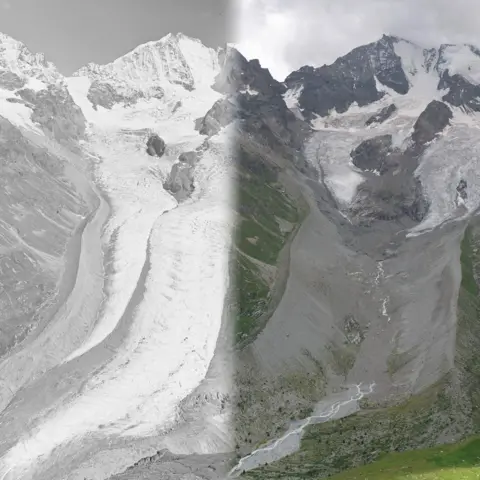
BBC Blended image comparison of the Tschierva Glacier in 1935 on the left and 2022 on the right. The glacier extends far down the valley in 1935 but has retreated way up the valley by 2022.BBC

When Matthias Huss first visited Rhône Glacier in Switzerland 35 years in the past, the ice used to be only a decrease travel from the place his oldsters would soil the automobile.

“When I first stepped onto the ice… there [was] a special feeling of eternity,” says Matthias.

These days, the ice is part an future from the similar parking spot and the scene may be very other.

“Every time I go back, I remember how it used to be,” recollects Matthias, now director of Glacier Tracking in Switzerland (GLAMOS), “how the glacier looked when I was a child.”

There are alike tales for lots of glaciers in all places the planet, as a result of those frozen rivers of ice are backing out – speedy.

In 2024, glaciers out of doors the immense ice sheets of Greenland and Antarctica misplaced 450 billion tonnes of ice, consistent with a contemporary Global Meteorological Group file.

That’s an identical to a hamper of ice 7km (4.3 miles) imposing, 7km huge and 7km deep – enough quantity H2O to fill 180 million Olympic swimming swimming pools.

“Glaciers are melting everywhere in the world,” says Prof Ben Marzeion of the Institute of Geography on the College of Bremen. “They are sitting in a climate that is very hostile to them now because of global warming.”

Switzerland’s glaciers had been in particular badly strike, dropping 1 / 4 in their ice within the latter 10 years, measurements from GLAMOS visible this moment.

“It’s really difficult to grasp the extent of this melt,” explains Dr Huss.

However footage – from length and the grassland – inform their very own tale.

Satellite tv for pc photographs display how the Rhône Glacier has modified since 1990, when Dr Huss first visited. On the entrance of the glacier is a puddle the place there impaired to be ice.
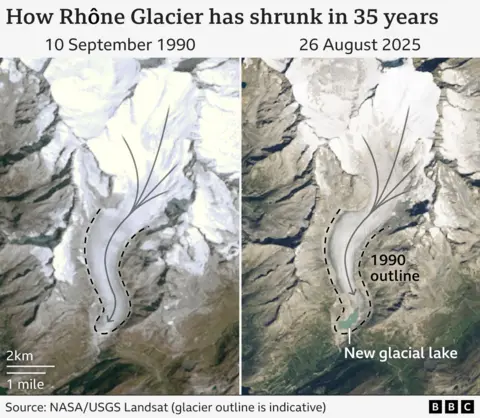
Satellite images showing how Rhône Glacier has shrunk between 1990 and 2025. The glacier flows from top to bottom of the image. The glacier front has noticeably retreated, and a glacial lake is now visible where the ice used to be.

Till not too long ago, glaciologists within the Alps impaired to imagine 2% of ice misplaced in one future to be “extreme”.

Later 2022 blew that concept out of the H2O, with just about 6% of Switzerland’s too much ice misplaced in one future.

That has been adopted by means of important losses in 2023, 2024 and now 2025 too.

Regine Hock, teacher of glaciology on the College of Oslo, has been visiting the Alps because the Seventies.

The adjustments over her lifetime are “really stunning”, she says, however “what we see now is really massive changes within a few years”.

The Clariden Glacier, in north-eastern Switzerland, used to be more or less in stability till the overdue twentieth Century – gaining about as a lot ice thru snowstorm because it misplaced to melting.

However this century, it’s melted abruptly.
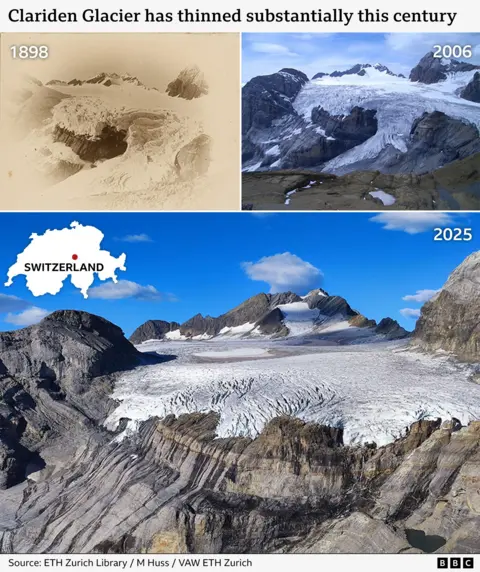
Two images showing Clariden Glacier in 1898 and 2006, above a larger image of the same glacier in 2025. The glacier has visibly shrunk between 1898 and 2006, but the changes between 2006 and 2025 are even more noticeable: the ice is thinner and has retreated.

For lots of smaller glaciers, just like the Pizol Glacier within the north-east Swiss Alps, it’s been excess.

“This is one of the glaciers that I observed, and now it’s completely gone,” says Dr Huss. “It definitely makes me sad.”

Images permit us to appear even additional again in date.

The Gries Glacier, in southern Switzerland close the Italian border, has retreated by means of about 2.2km (1.4 miles) within the era century. The place the top of the glacier as soon as stood is now a immense chilly puddle.
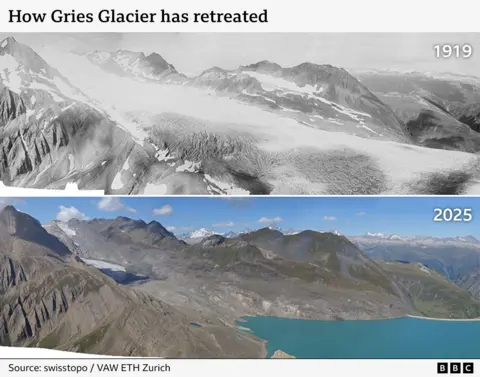
Two images of Gries Glacier, one in 1919 above and one in 2025 below. In 1919 a thick glacier is flowing from left to right, extending off the page. In 2025 the glacier only just enters at the left-hand side of the image. Where the ice once was is a large area of exposed bedrock, followed by a bright blue glacier lake.

In south-east Switzerland, the Pers Glacier as soon as fed the bigger Morteratsch Glacier, which flows unwell against the valley. Now the 2 now not meet.

And the biggest glacier within the Alps, the Splendid Aletsch, has receded by means of about 2.3km (1.4 miles) over the era 75 years. The place there used to be ice, there are actually bushes.
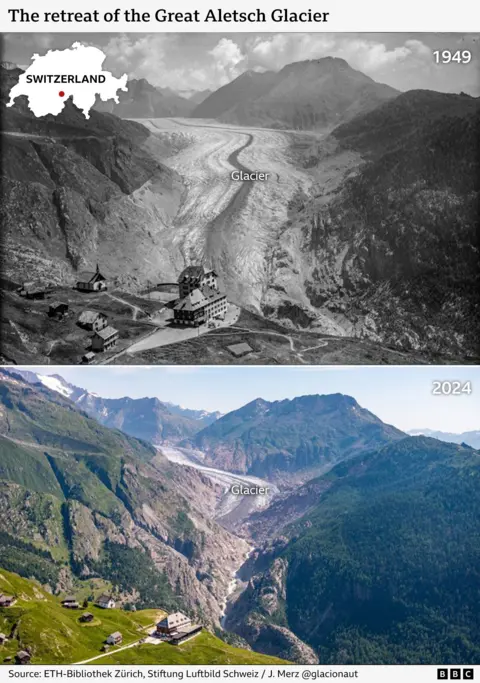
Two images of the Great Aletsch Glacier, one in 1949 above and one in 2024 below. The glacier emerges in between two steep valley walls. In 1949, the glacier extends almost all the way down the image; in 2024, it only just emerges in the background. There are trees and bedrock where there used to be ice.

Glaciers have grown and gotten smaller naturally for hundreds of thousands of years, in fact.

Within the chilly snaps of the seventeenth, 18th and nineteenth Centuries – a part of the Modest Ice While – glaciers incessantly complex.

All through this date, many have been thought to be cursed by means of the satan in Alpine folklore, their advances related to religious forces as they threatened hamlets and field.

There are even stories of villagers calling on clergymen to speak to the spirits of glaciers and get them to journey up the mountain.

Glaciers started their frequent retreat around the Alps in about 1850, regardless that the timing numerous from park to park.

That coincided with emerging industrialisation, when burning of fossil fuels, in particular coal, started to warmth up our order, however it’s juiceless to disentangle herbal and human reasons that some distance again in date.

The place there is not any actual indecision is that the in particular speedy losses of the era 40 years or so don’t seem to be herbal.

With out humans warming the planet – by means of burning fossil fuels and liberating excess quantities of carbon dioxide (CO2) – glaciers could be anticipated to be more or less solid.

“We can only explain it if we take into account CO2 emissions,” confirms Prof Marzeion.

What’s much more sobering is that those immense, flowing our bodies of ice can tug a long time to totally alter to the abruptly warming order. That signifies that, even supposing international temperatures stabilised day after today, glaciers would proceed to retreat.

“A large part of the future melt of the glaciers is already locked in,” explains Prof Marzeion. “They are lagging climate change.”

However all isn’t misplaced.

Part of the ice too much internationally’s mountain glaciers might be guarded if global warming is limited to 1.5C above “pre-industrial” ranges of the overdue 1800s, consistent with analysis printed this future in the journal Science.

Our wave trajectory is eminent us against warming of about 2.7C above pre-industrial ranges by means of the top of this century – which might see three-quarters of ice misplaced sooner or later.

That remaining H2O going into rivers and sooner or later the oceans way upper sea ranges for coastal populations world wide.

However the lack of ice can be in particular acutely felt by means of mountain communities depending on glaciers for pristine H2O.

Glaciers are a bit of like immense reservoirs. They bind H2O as snowstorm – which becomes ice – right through chilly, rainy sessions, and leave it as meltwater right through heat sessions.

This meltwater is helping to stabilise river flows right through scorching, juiceless summers – till the glacier disappears.

The lack of that H2O useful resource has knock-on results for all those that depend on glaciers – for irrigation, consuming, hydropower or even delivery site visitors.

Switzerland isn’t excepted from the ones demanding situations, however the implications are a lot more profound for the prime mountains of Asia, referred to by means of some because the 3rd Pole because of the quantity of ice.

About 800 million society depend no less than in part on meltwater from glaciers there, in particular for agriculture. That incorporates the higher Indus river basin, which serves portions of China, Republic of India, Pakistan, and Afghanistan.

In areas with drier summers, meltwater from ice and snow will also be the one important supply of H2O for months.

“That’s where we see the biggest vulnerability,” says Prof Hock.

So how do scientists really feel when faced by means of the presen possibilities of glaciers in a warming international?

“It’s sad,” says Prof Hock. “But at the same time, it’s also empowering. If you decarbonise and reduce the [carbon] footprint, you can preserve glaciers.

“Now we have it in our palms.”

Supremacy picture: Tschierva Glacier, Swiss Alps, in 1935 and 2022. Credit score: swisstopo and VAW Glaciology, ETH Zurich.

Additional reporting by Dominic Bailey and Erwan Rivault.

Thin, green banner promoting the Future Earth newsletter with text saying, “The world’s biggest climate news in your inbox every week”. There is also a graphic of an iceberg overlaid with a green circular pattern.


Source link

Share. Facebook Twitter Pinterest LinkedIn WhatsApp Reddit Tumblr Email
Savannah Herald
  • Website

Related Posts

Science December 21, 2025

‘We’ve all grown up with radiators

Science November 27, 2025

At COP30, China’s funding in inexperienced tech offer gleam of hope

Science November 6, 2025

Medieval Clinical Incorrect information Persists

Science October 20, 2025

Bowers & Wilkins Px8 S2 noise-cancelling wi-fi headphones evaluate: Turning transit into theatre

Science October 18, 2025

October’s Night time Sky Notes: Let’s Progress, LIGO!

Science August 31, 2025

AI Spots Secret Indicators of Awareness in Comatose Sufferers prior to Docs Do

Comments are closed.

Don't Miss
Business September 25, 2024

Mother Arrested After Allegedly Shooting 13-Year-Old Daughter

by Cedric ‘BIG CED’ Thornton September 25, 2024 Detectives have arrested and charged 32-year-old Talecka…

American Airways Simply Made The use of Go back and forth Credit A lot More uncomplicated — What to Know

November 8, 2024

Congress takes up new funding bill

September 27, 2024

This Beneath-the-radar Caribbean Island Is About to Turn into the After Heavy Vacation spot

November 24, 2024

America Govt Is Now not a Startup

February 7, 2025
Categories
  • Business
  • Classifed Ads
  • Climate
  • Education
  • Entertainment
  • Gaming
  • Health
  • Local
  • National
  • Politics
  • Science
  • Sports
  • State
  • Tech
  • Tourism
  • World
About Us
About Us

Savannah Herald is your trusted source for the pulse of Coastal Georgia and beyond. We're committed to delivering authentic, timely news that resonates with our community.

From local politics to business developments, we're here to keep you informed and engaged. Our mission is to amplify the voices and stories that matter, shining a light on our collective experiences and achievements.
We cover:
🏛️ Politics
💼 Business
🎭 Entertainment
🏀 Sports
🩺 Health
💻 Technology
Savannah Herald: Savannah's Black Voice 💪🏾

Our Picks

Op-Ed: Unheard and Underserved: The Have an effect on of Ignoring Dim-Owned Media

November 26, 2024

UGA Membership Hockey workforce to discuss with native youngsters’s health facility

January 15, 2025

58 Easiest Dim Friday Offer for Amazon High Participants

November 30, 2024

At the back of Timberwolves’ resolution to start out Joe Ingles so his autistic son may see him play games

March 23, 2025

Salesforce Appoints Robin Washington as President and Prominent Running and Monetary Officer

February 12, 2025
Categories
  • Business
  • Classifed Ads
  • Climate
  • Education
  • Entertainment
  • Gaming
  • Health
  • Local
  • National
  • Politics
  • Science
  • Sports
  • State
  • Tech
  • Tourism
  • World
  • Privacy Policy
  • Disclaimer
  • Terms and Conditions
  • About Us
  • Contact Us
  • Opt-Out Preferences
Copyright © 2002-2025 Savannahherald.com All Rights Reserved. A Veteran-Owned Business

Type above and press Enter to search. Press Esc to cancel.

Manage Consent
To provide the best experiences, we use technologies like cookies to store and/or access device information. Consenting to these technologies will allow us to process data such as browsing behavior or unique IDs on this site. Not consenting or withdrawing consent, may adversely affect certain features and functions.
Functional Always active
The technical storage or access is strictly necessary for the legitimate purpose of enabling the use of a specific service explicitly requested by the subscriber or user, or for the sole purpose of carrying out the transmission of a communication over an electronic communications network.
Preferences
The technical storage or access is necessary for the legitimate purpose of storing preferences that are not requested by the subscriber or user.
Statistics
The technical storage or access that is used exclusively for statistical purposes. The technical storage or access that is used exclusively for anonymous statistical purposes. Without a subpoena, voluntary compliance on the part of your Internet Service Provider, or additional records from a third party, information stored or retrieved for this purpose alone cannot usually be used to identify you.
Marketing
The technical storage or access is required to create user profiles to send advertising, or to track the user on a website or across several websites for similar marketing purposes.
Manage options Manage services Manage {vendor_count} vendors Read more about these purposes
View preferences
{title} {title} {title}
Ad Blocker Enabled!
Ad Blocker Enabled!
Our website is made possible by displaying online advertisements to our visitors. Please support us by disabling your Ad Blocker.